



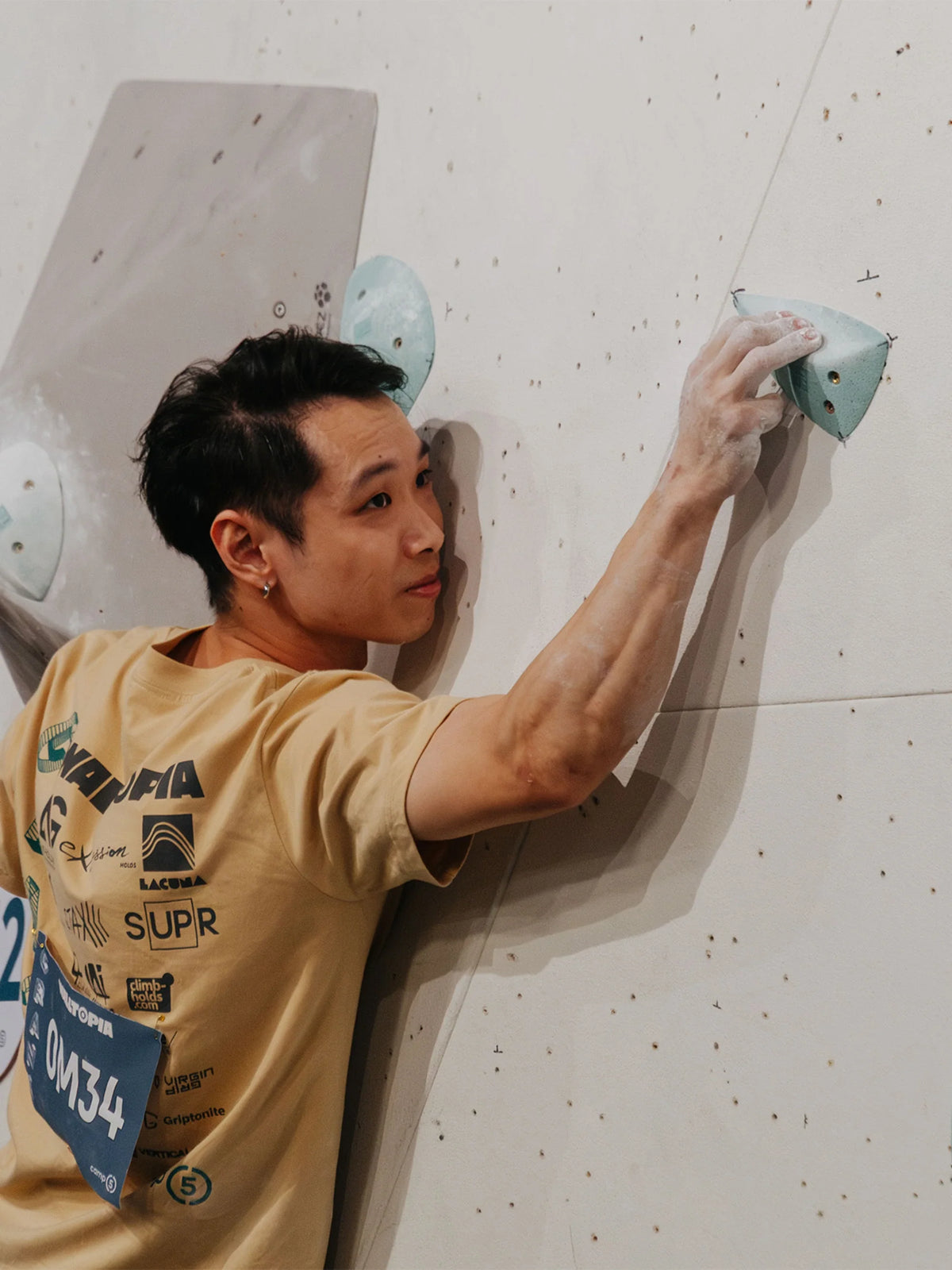
-- SUGGESTED HERO IMAGE: A climber with hips close to the wall, weight clearly over a foot, about to move — a "just before the move" moment -->
Most climbers think they fall because they're "not strong enough."
In reality, it's usually something else. Their hips weren't in the right place. They pulled too early. Their feet weren't stable. Their weight was slightly off. Their timing was wrong by a fraction of a second.
Strength matters. But movement matters more, and two parts of movement quietly decide more falls than any lack of power: where your body is, and when you move it.
How Positioning Unlocks Movement
-- SUGGESTED IMAGE: Close-up of a climber's hips and feet on the wall, showing weight over the foot — the "positioning" detail -->

Good positioning lets the hold work for you. Bad positioning makes the exact same hold feel impossible.
That's why you can watch one climber fall off a move, then watch another climber stick it without breaking a sweat. The holds are the same. The difference is often just a few centimetres: hips a little closer to the wall, a foot a little higher, a shoulder turned slightly more. Tiny adjustments like these can be the difference between sticking a move and peeling off.
Positioning shapes four things on every move:
- Stability. A well-placed body sits on its feet instead of hanging off its arms, so you're not fighting to stay on the wall before you even start the move.
- Balance. Where your weight sits decides whether you feel steady or like you're about to swing off. Small shifts in your hips can restore balance without any extra effort.
- Tension. Staying connected through your core and feet keeps your body tight to the wall, so the force you apply to holds goes where you want it.
- Direction of force. Every hold is meant to be pulled or pushed in a certain direction. When your body is positioned to load it that way, the hold feels better. When it isn't, you slip off a hold that was perfectly usable.
If a move feels impossible, it's worth asking whether you're strong enough or whether you're simply in the wrong place to do it. The answer is often the second one.
Timing Is Everything
If positioning is where your body is, timing is when it moves. Timing is what tells you:
- When to pull. Pulling once your body is in position makes the move efficient. Pulling before then makes it feel much harder than it is.
- When to push. Many moves are really leg moves. Pushing at the right moment lets your legs do the work your arms usually try to do.
- When to shift. Weight transfers need to happen before the next move starts, not halfway through it.
- When to commit. Hesitating mid-move wastes momentum, while committing too early before you're set up wastes energy.
Pull too early and you fall. Pull too late and you fall. Move at the wrong moment and you fall. Timing is the quiet, invisible skill that strong climbers rely on, and it's why two climbers of equal strength can have very different results on the same problem.
Why Beginners Struggle With Timing and Positioning
If this all sounds hard, that's because it is, at first. Beginners tend to struggle with positioning and timing for a few understandable reasons:
- They climb too fast. Rushing doesn't leave time to set up a position or wait for the right moment to move.
- They overgrip. Squeezing every hold tightly makes the whole body tense, which makes small adjustments almost impossible.
- They rely on their arms. Arms are the first thing most people reach for, so legs and hips don't get a chance to help.
- They can't yet feel weight shifts. Sensing where your weight is takes time and practice. Until that feeling develops, it's very hard to tell why a move isn't working.
This is completely normal, and it's very fixable. Nobody is born able to feel where their hips are on a wall. It's learned, the same way every other part of climbing is learned.
How to Start Feeling It
-- SUGGESTED IMAGE: A climber practising a slow, deliberate move on an easier wall — shows drill-style practice -->
You can begin building this awareness on your next session without changing anything about what you climb. Pick an easy problem, well within your ability, and try one of these:
- Pause before every move. Take one breath, check where your weight is, and only then move. It slows you down just enough to notice what's happening.
- Test your feet. On each foot you step onto, ask yourself whether you can feel your weight sitting over it. If not, adjust before pulling.
- Move your hips first. Before reaching for the next hold, move your hips to where they'd be most comfortable. See how much shorter the reach feels.
- Repeat the same move. Try a single move five times, changing one small thing each time. Notice which version feels easiest, and why.
This works on any climb, at any level. The goal isn't to climb harder things. It's to start noticing what your body is doing, because you can't fix what you can't feel.
The Aruta Academy Perspective
At Aruta Academy, we teach climbers to feel their movement.
The Aruta Method focuses on building that awareness step by step:
- Awareness. Learning to notice where your body is and what it's doing mid-move.
- Alignment. Placing your hips, feet and shoulders so the hold works for you.
- Precision. Making small, deliberate adjustments instead of big, panicked ones.
- Timing-based drills. Exercises designed to teach when to pull, push, shift and commit.
- Micro-adjustments to your sequence. Small changes in how you approach a move, like a different foot, a turned hip or a slightly different order, that make it feel dramatically easier.
Once your positioning and timing improve, climbing gets easier without needing extra strength. Climbs that felt out of reach often start to feel possible, simply because you're finally in the right place at the right moment.
If you want to climb smarter, not harder, join our free trial session and let us show you where your movement can improve.


Share:
Movement & Fluidity — Make Climbing Feel Like a Dance