



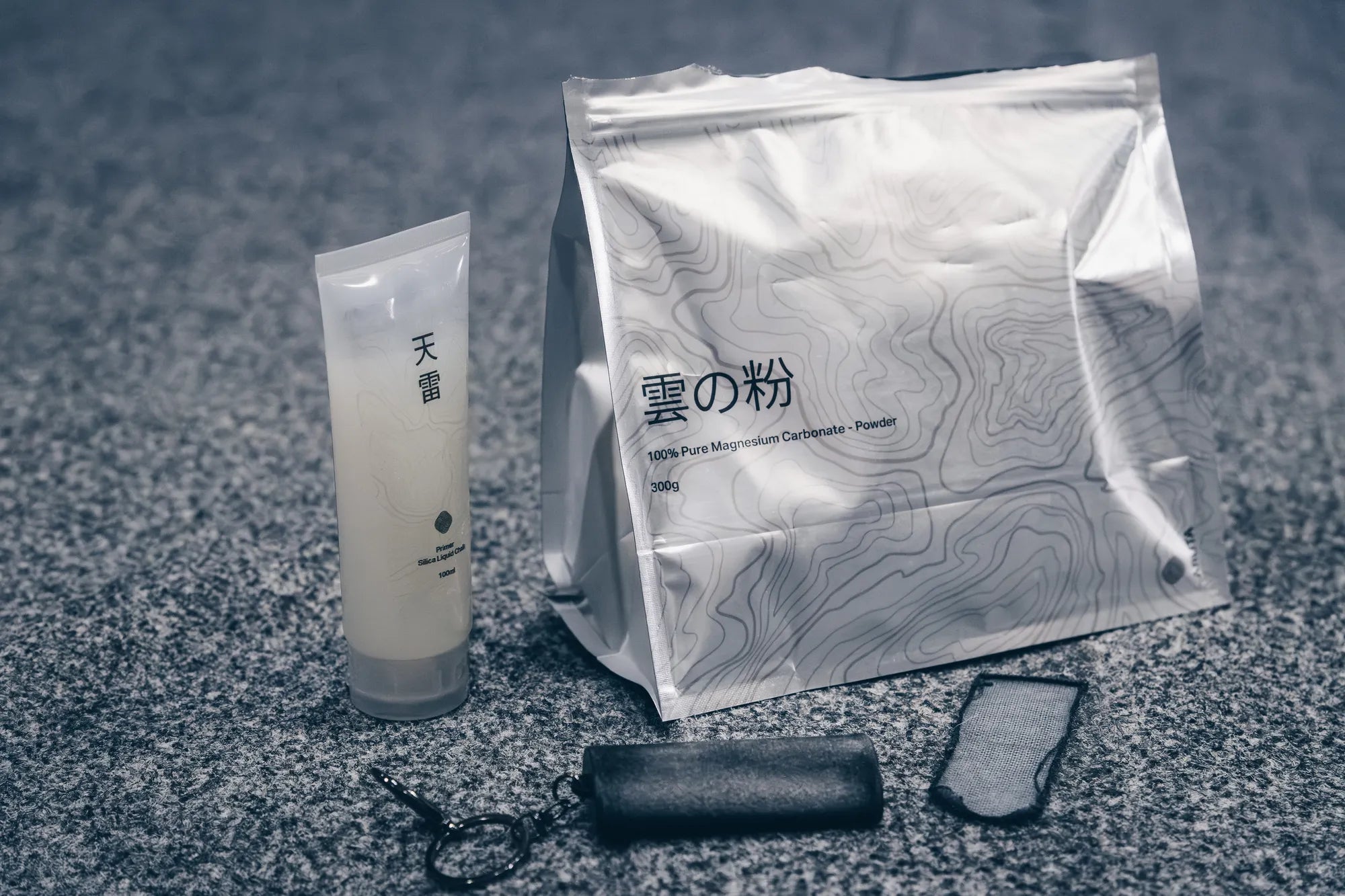
Chalk is the most used piece of climbing equipment after shoes, yet most climbers give it almost no thought. They grab whatever's available, apply it liberally, and assume grip problems are about technique or conditions rather than chalk choice or application.
This guide covers everything worth knowing about climbing chalk: what it's made of, the different formats and how they perform, how to choose based on your skin type and the conditions you climb in, and the habits that make chalk work better across a session and a training week.
What Climbing Chalk Is Made Of

Standard climbing chalk is magnesium carbonate — MgCO₃. It absorbs moisture from the skin surface and increases friction between fingers and holds. It is not the same compound as blackboard chalk, which is calcium carbonate and has no meaningful moisture absorption capability.
Powder chalk varies by particle size. Fine chalk spreads evenly and absorbs moisture quickly. Chunky or block chalk breaks down more slowly and gives a different texture on application. Mix variants combine both for climbers who want the speed of fine chalk with some texture from larger pieces. Kumo comes in powder and mix variants.
Liquid chalk suspends magnesium carbonate in alcohol. When applied, the alcohol evaporates and leaves a chalk layer bonded directly to the skin. The alcohol provides an additional drying effect on application, which is why liquid chalk performs better than powder as a base layer in humid conditions.
Silica-based liquid chalk — like Thunder — replaces some of the magnesium carbonate with silicon dioxide, a desiccant that continues absorbing moisture after the initial application rather than just depositing a static chalk layer. In sustained humidity, this makes a measurable difference to how long grip holds before sweat breaks it down. For a full breakdown of chalk chemistry, see what is climbing chalk made of.
Chalk Formats: Loose, Ball, and Liquid

The three main chalk formats serve different purposes and perform differently depending on conditions.
Loose chalk in a chalk bag is the most common format. Fast to apply, easy to control quantity, and best suited to bouldering sessions with frequent short attempts. The downside is dust production and faster moisture absorption from the air — loose chalk left open in a humid gym clumps faster than any other format.
Chalk balls release chalk through a mesh pouch, producing significantly less airborne dust. Many gyms require chalk balls for this reason. The trade-off is slower application — chalk balls can't deliver coverage fast enough in high-sweat sessions, making them better suited to moderate conditions or gyms with strict chalk policies.
Liquid chalk is the base layer format. It bonds directly to skin rather than sitting on top, holds longer in humidity, and produces no airborne dust. It requires 20–30 seconds to set fully and isn't suited to quick between-attempt reapplication. The optimal approach in humid gyms is liquid chalk as a base, with powder or a chalk ball for top-ups. For a full format comparison, see chalk bag vs chalk ball vs loose chalk.
How to Use Liquid Chalk Properly
Liquid chalk is the most misused format. The most common mistakes are applying too much and not waiting for it to dry.
The right amount is roughly the size of a 50-cent coin dispensed into one palm — enough for both hands. Rub thoroughly across the entire palm, each finger, and down to the first knuckle. Wait until the alcohol smell fades and hands feel completely dry before touching a hold — typically 20–30 seconds. Climbing before the chalk has set transfers product onto holds rather than keeping it on skin.
Use liquid chalk as a base layer at the start of a session and after significant breaks. For between-attempt top-ups, switch to powder. Applying liquid chalk over heavy powder buildup prevents proper bonding — wipe hands first if there's significant powder residue before reapplying. For full application guidance, see how to use liquid chalk properly.
Choosing Chalk for Your Skin Type

Skin type determines which chalk format and application approach works best. The relevant variables are sweat rate, baseline skin moisture, and sensitivity to drying.
Sweaty hands need a strong base layer. Silica liquid chalk outperforms standard powder because it continues managing moisture rather than saturating quickly. Apply Thunder as a base, use minimal powder top-ups, and wipe hands between attempts before re-chalking rather than layering chalk on top of sweat.
Dry hands often need less chalk than climbers assume. Powder is usually sufficient; liquid chalk should be used sparingly to avoid accelerating the cumulative drying that leads to cracking and splits. Post-session moisturising is non-negotiable for dry-handed climbers.
Sensitive skin reacts to both the alkaline pH of magnesium carbonate and the alcohol in liquid chalk. Minimise liquid chalk frequency, wash hands thoroughly post-session, and moisturise consistently as a daily habit on climbing days rather than only when skin feels bad.
Conditions shift effective skin type — normal hands in a cool gym become effectively sweaty hands in a hot, humid Singapore gym. Adjust chalk approach based on how the session is going, not just baseline skin type. For a detailed guide, see how to choose climbing chalk for your skin type.
Why Less Chalk Is Usually More Effective
The instinct when grip fails is to apply more chalk. This is almost always counterproductive. Excess chalk reduces tactile sensitivity, mixes with sweat to form a paste that actively reduces friction, and deposits onto holds faster — degrading grip for every climber on that problem.
The optimal chalk layer is thin and even. A well-applied liquid chalk base plus light powder top-ups outperforms heavy repeated powder application in every condition, but especially in humidity. If grip is degrading rapidly despite fresh chalk, the issue is sweat rate outpacing chalk capacity — the solution is better chalk choice, not more chalk. For a full breakdown of over-chalking and its effects, see is too much chalk bad for your climbing.
Chalk Storage and Shelf Life
Powder chalk doesn't have a chemical expiry date, but it degrades in performance as it absorbs moisture. Mildly clumped chalk can be broken up and still performs; heavily clumped chalk that has hardened throughout is pre-saturated and won't absorb sweat effectively. In Singapore's humidity, proper storage matters more than it would in a dry climate.
Store powder chalk in an airtight container away from heat. Only transfer a session's worth into your chalk bag rather than storing the full supply there. Liquid chalk degrades as alcohol evaporates — keep the cap closed between uses, store at room temperature, and shake before each session to redistribute the suspension. For a full guide, see does climbing chalk expire or go bad.
Chalk and Skin Care
Chalk affects skin directly. Magnesium carbonate is mildly alkaline and draws moisture from skin over time. Alcohol in liquid chalk amplifies this effect. The cumulative result across a training week is skin that becomes progressively drier and more prone to cracking, splitting, and flappers — particularly in humid conditions where skin is already under more stress than in dry climates.
The offsets are straightforward: wash hands thoroughly after every session to remove chalk residue, moisturise before sleep as a default habit on climbing days, and avoid over-chalking which accelerates drying beyond what training volume alone would cause. Chalk habits and skin care habits are directly linked — poor chalk habits make skin care harder, and good skin care habits give you more tolerance for necessary chalk use. For detailed guidance on managing skin around chalk use, see the complete guide to climbing chalk in humid conditions.
Quick Reference: Chalk Use by Situation
Humid gym, sweaty hands: Thunder liquid chalk base, light Kumo powder top-ups, wipe between attempts, reapply base when it breaks down.
Humid gym, dry hands: Kumo powder as primary format, Thunder liquid chalk base for key attempts only, moisturise post-session without fail.
Gym with chalk ball policy: Thunder liquid chalk base, chalk ball for top-ups, keep ball in airtight bag between sessions.
Outdoor climbing: loose chalk or mix variant, liquid chalk for long routes or highball problems where mid-climb re-chalking isn't possible.
Sensitive skin: minimal liquid chalk use, powder as primary format, consistent post-session washing and moisturising.
Key Takeaways
- Climbing chalk is magnesium carbonate — silica-based liquid chalk adds active moisture absorption on top of the chalk layer
- Liquid chalk is a base layer tool; powder and chalk balls are for top-ups between attempts
- In humid gyms, liquid chalk base plus light powder top-ups outperforms any single-format approach
- Less chalk applied deliberately outperforms more chalk applied carelessly — for grip and for skin
- Store chalk properly; humidity degrades powder chalk and heat degrades liquid chalk faster than most climbers expect
- Chalk habits and skin care habits are linked — what you do with chalk directly affects how your skin holds up across a training week

Share:
Is Too Much Chalk Bad for Your Climbing?
What Is Bouldering? How It Differs from Other Types of Climbing