



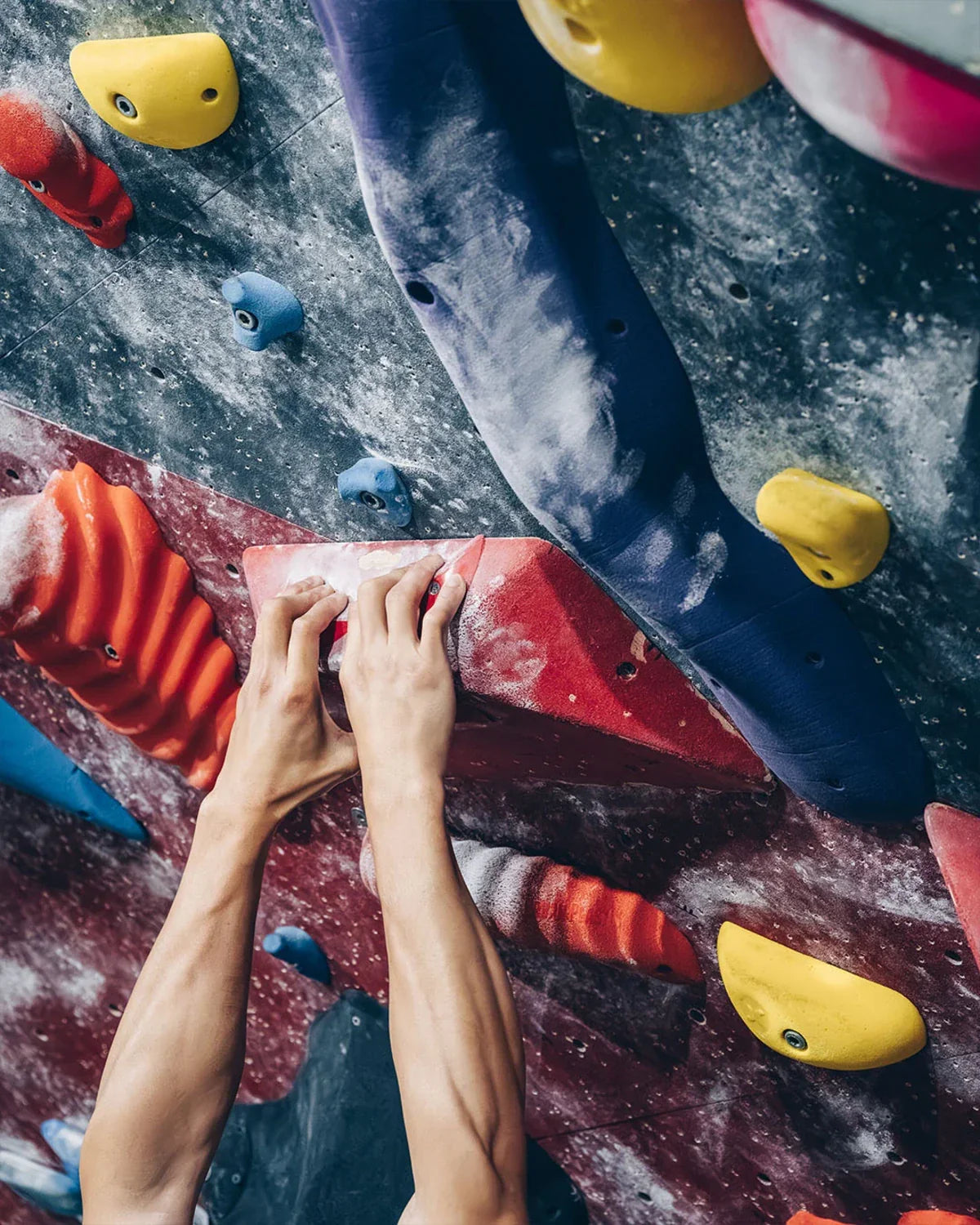
Finger strength is the most talked-about physical attribute in climbing, and it's also the one beginners are most likely to train incorrectly. The instinct is to jump straight to fingerboards and hangboard protocols designed for intermediate and advanced climbers, when the truth is that beginners get almost all their finger strength gains from climbing itself — and isolated finger training too early is one of the more reliable ways to get injured.
This article covers what actually builds finger strength in the early months, why fingerboards are premature for most beginners, and when it's genuinely time to add dedicated finger training.
How Finger Strength Actually Develops
Finger strength in climbing comes from two adaptations happening simultaneously: the muscles in your forearms and hands getting stronger, and the tendons and pulleys in your fingers getting more resilient to load. These two systems adapt at very different speeds. Muscles respond to training within weeks. Tendons and the pulley system — the fibrous bands that keep tendons close to the bone as fingers flex — adapt far more slowly, often over many months.
This mismatch is the central issue with finger training for beginners. Your muscles will feel ready for more intense finger loading well before your tendons actually are. Trusting how your muscles feel, rather than respecting how long tendons genuinely take to adapt, is how most beginner finger injuries happen.
Why Climbing Itself Is Enough at First
For the first several months of consistent climbing, the volume of finger loading from climbing itself is sufficient to build meaningful strength. Every problem you climb loads your fingers through a variety of grip types — crimps, slopers, pinches, jugs — in a way that's naturally varied and self-limiting. If a hold is too small or the angle too awkward, you simply can't hold it, which provides a built-in safety ceiling that isolated finger training doesn't have.
This variety also matters for tendon adaptation specifically. Climbing on a range of hold types and angles distributes load across different parts of the finger's connective tissue rather than repeatedly stressing the same narrow range of motion, which is what happens with repetitive isolated hangs on a fixed edge size.
Beginners who climb consistently — two to three sessions a week — typically see steady finger strength improvement for six months to a year purely from climbing volume, without needing any supplementary finger training at all.
Why Fingerboards Are Premature for Beginners

A fingerboard — also called a hangboard — is a training tool with a fixed set of edges and pockets designed for isolated finger strength training, usually by hanging from it with some or all of your body weight. It's a legitimate and widely used tool for intermediate and advanced climbers, but it applies concentrated, repetitive load to a very specific position and edge size — exactly the kind of loading pattern that beginner tendons aren't ready for.
Climbing itself is inherently variable — you're never gripping the exact same edge in the exact same position for many reps in a row. Fingerboarding removes that variability by design, which is part of what makes it effective for targeted strength training, but also what makes it risky before your connective tissue has built a baseline of resilience through more varied loading.
Most beginners simply don't need the strength gains a fingerboard provides yet. In the first year, technique and movement efficiency contribute far more to climbing performance than raw finger strength does. A beginner who climbs regularly and focuses on technique will out-progress a beginner who adds fingerboard training early but neglects movement skill.
When It's Time to Consider Fingerboard Training
A reasonable general guideline is waiting until you've been climbing consistently for at least a year before introducing any structured fingerboard work. By that point, your tendons and pulleys have had significant time to adapt to climbing-specific loading, and you're more likely to have the body awareness to recognise early warning signs of overload before they become injuries.
Beyond time, a few signals suggest you're ready to consider it: you're climbing consistently without recurring finger soreness, you have reasonably solid technique such that grip strength is now a genuine limiting factor rather than technique gaps, and you understand proper fingerboard protocols well enough to start conservatively rather than diving into an aggressive program.
If and when you do start, begin with very low intensity and volume, use larger edges rather than small crimps, and progress gradually over months, not weeks. Working with a coach or experienced climber for your first fingerboard sessions is worth the investment — poor technique on a fingerboard significantly increases injury risk.
What Beginners Should Do Instead
Rather than isolated finger training, the highest-value focus for a beginner's first year is climbing volume with attention to technique, combined with basic injury-prevention habits. Warming up properly before climbing prepares tendons for load; a full warm-up routine is covered in a companion article in this cluster.
Antagonist training — strengthening the muscles that work in opposition to the pulling and gripping muscles climbing emphasises — is a better early investment than finger-specific training. It builds structural balance around the joints climbing stresses and reduces injury risk without adding load to fingers specifically. This is covered in more depth elsewhere in this cluster.
Paying attention to how your hands feel after sessions matters more than any specific training protocol at this stage. Persistent soreness in a specific finger, tenderness at the base of a finger near the palm, or any sharp pain during a grip are all signals to back off immediately rather than push through, regardless of how motivated you feel to keep training.
Recognising Overload Before It Becomes an Injury
Normal muscle fatigue from climbing feels like a burning or tired sensation in your forearms that resolves within a day or two. Tendon or pulley overload feels different — often a dull ache, tightness, or tenderness localised to a specific joint or the base of a finger, and it tends to linger longer than normal fatigue, sometimes for several days.
If you notice this kind of localised, lingering discomfort, the right response is rest, not pushing through with the assumption that it will work itself out. Climbing on an already-strained pulley significantly increases the risk of a more serious injury, which can take months to fully recover from. A few days off at the first sign of tendon-specific discomfort is a far smaller cost than the alternative.
Key Takeaways
- Finger strength comes from both muscle and tendon adaptation — tendons adapt far more slowly than muscles
- Climbing itself provides sufficient, naturally varied finger loading for most beginners in their first six months to a year
- Fingerboards apply concentrated, repetitive load that beginner tendons usually aren't ready for
- Wait at least a year of consistent climbing before introducing structured fingerboard training
- Focus on technique, warm-ups, and antagonist training instead — these reduce injury risk without adding finger-specific load
- Localised, lingering finger discomfort — different from normal forearm fatigue — is a signal to rest immediately

Share:
How to Structure Your First Climbing Training Week
Antagonist Training: Why Climbers Need to Train Push Muscles Too