



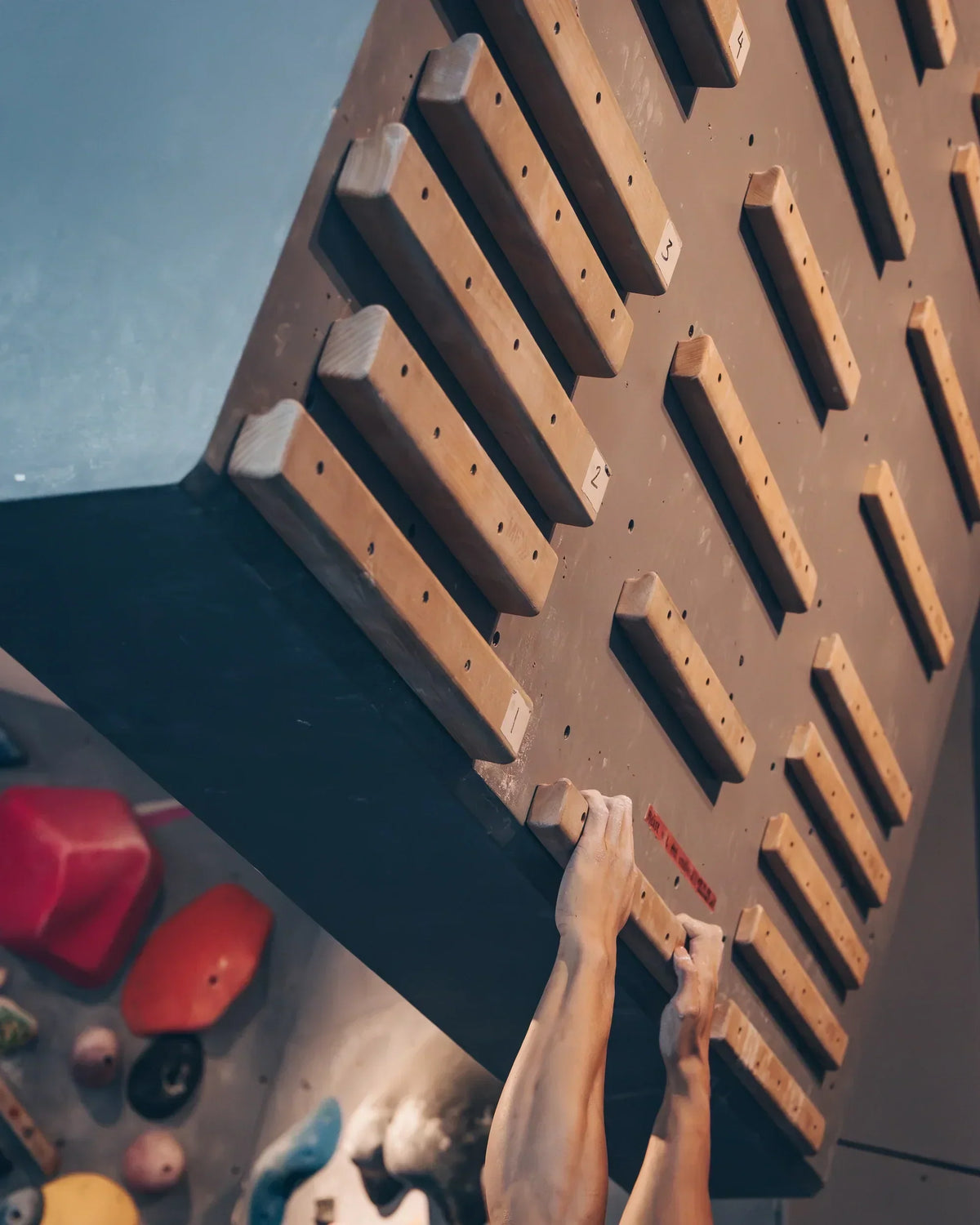
Most beginner climbing injuries share a common cause: enthusiasm outpacing the body's ability to adapt. Climbing is deceptively demanding on tendons and connective tissue in a way that isn't obvious from how a session feels in the moment, which is why the same handful of injuries show up again and again in climbers during their first year.
This article covers the most common injuries beginners encounter, how to recognise them early, and — more importantly — how to avoid them in the first place.
Finger Pulley Strains
The pulleys are fibrous bands that hold the finger tendons close to the bone as fingers flex around a hold. They're the single most commonly injured structure in climbing, particularly among beginners who haven't built up tendon resilience yet.
How it happens: pulley strains typically occur on small, crimped holds where fingers are gripped in a closed, curled position under significant load. Beginners are especially at risk because they haven't yet developed the tendon strength to handle crimping safely, and often don't recognise how much more stressful a crimp grip is compared to an open-hand grip on the same size hold.
What it feels like: a sudden, sharp pain at the base of a finger, on the palm side, often during a specific move rather than building gradually. Milder strains might just feel like tenderness or a dull ache in that area that lingers after the session, rather than a sharp acute pain.
Prevention: avoid heavy crimping in your first several months of climbing — favour open-hand grips where the finger joints are less acutely bent, even if this feels less secure at first. Proper warm-up matters significantly here, since cold pulleys are far more strain-prone than warmed-up ones. For a full warm-up routine, see how to warm up properly before climbing.
Climber's Elbow (Medial and Lateral Epicondylitis)
Climber's elbow refers to tendinopathy at the elbow, either on the inner side (medial, sometimes called golfer's elbow) or outer side (lateral, sometimes called tennis elbow). It develops gradually from repetitive strain rather than a single acute moment, which makes it easy to ignore in its early stages.
How it happens: the forearm muscles that flex fingers during gripping attach at the elbow. Constant gripping load, combined with the muscle imbalance between flexors and extensors that climbing naturally creates, puts repetitive strain on these tendon attachment points over weeks and months of consistent climbing.
What it feels like: a dull ache or tenderness on the inner or outer elbow, often worse with gripping activities and sometimes present even during simple daily tasks like carrying bags or turning a doorknob once it's developed. Unlike a pulley strain, this tends to build gradually rather than appearing suddenly.
Prevention: antagonist training — specifically wrist extension exercises and general push-muscle work — directly addresses the imbalance that contributes to this condition. Starting antagonist training early, within your first few months of climbing, is one of the more effective preventive measures available. For exercises and guidance, see antagonist training: why climbers need to train push muscles too.
Shoulder Impingement
Shoulder impingement involves irritation of the tendons and bursa in the shoulder, often from repetitive overhead and rotational movement combined with the muscle imbalances climbing tends to create around the joint.
How it happens: climbing repeatedly asks the shoulder to work in extended, rotated positions — particularly on overhangs and reaches — without much corresponding work for the muscles that stabilise the shoulder in the opposite pattern. Over time, this imbalance changes how the shoulder moves and can lead to tendons or the bursa getting pinched during certain movements.
What it feels like: pain or discomfort at the front or top of the shoulder, often triggered by overhead reaching or specific climbing positions, sometimes with a catching or pinching sensation during particular movements.
Prevention: the same antagonist training that helps prevent climber's elbow — particularly external rotation exercises and reverse fly movements — directly targets the muscle imbalance contributing to shoulder impingement. Proper warm-up that includes shoulder mobility work before climbing also plays a meaningful role in prevention.
Skin Tears: Flappers and Splits
Less serious than the tendon and joint injuries above, but far more common day-to-day, especially for beginners still building callus and skin toughness.
How it happens: flappers occur when a raised skin edge — usually an under-maintained callus — catches on a hold and peels back. Splits happen when dry, overworked skin cracks, usually at fingertips or skin creases. Both are more frequent in Singapore's humidity, where skin softens faster and takes longer to toughen than in dry climates.
What it feels like: immediate, sharp discomfort at the moment of injury, followed by a raw or exposed patch of skin that's sensitive to further contact and needs time to heal before returning to full climbing volume on that hand.
Prevention: regular callus filing after sessions, proper chalk habits, and a consistent post-session moisturising routine meaningfully reduce both flapper and split frequency. For a complete guide, see the complete guide to climbing skin care in humid conditions.
General Overuse and Fatigue Injuries
Beyond the specific injuries above, a broader category of overuse injury shows up in beginners who climb too frequently without enough recovery between sessions. This isn't always a single identifiable injury — it can manifest as generalised soreness, reduced performance, or a collection of minor niggles that don't resolve.
How it happens: climbing more than two to three times a week as a beginner, without enough rest days for tendons to recover, is the most common contributing pattern. Tendons adapt more slowly than muscles, so a schedule that feels sustainable for muscle recovery can still be overloading connective tissue. For guidance on structuring a sustainable schedule, see how to structure your first climbing training week.
Prevention: respecting rest days, paying attention to lingering soreness rather than pushing through it, and building session frequency gradually over months rather than jumping straight into a high-frequency schedule.
When to See a Professional
Sharp, sudden pain during a specific move — particularly in a finger, elbow, or shoulder — that doesn't resolve within a few days of rest warrants seeing a physiotherapist or sports doctor familiar with climbing injuries. Similarly, any pain that's present during normal daily activities, not just climbing, is worth getting properly assessed rather than continuing to climb through it.
Minor soreness that resolves within a day or two and doesn't recur is generally normal adaptation. The distinction between normal fatigue and something that needs professional attention is often about duration and whether the discomfort is localised to a specific structure — a joint, a tendon attachment point — rather than the generalised muscle fatigue that's expected after a good session.
Key Takeaways
- Finger pulley strains are the most common beginner injury — avoid heavy crimping early and warm up properly
- Climber's elbow develops gradually from repetitive gripping combined with muscle imbalance — antagonist training helps prevent it
- Shoulder impingement stems from the same imbalance pattern — external rotation and reverse fly exercises are protective
- Flappers and splits are common but largely preventable with regular skin maintenance and a proper post-session routine
- General overuse injuries usually trace back to climbing frequency outpacing tendon recovery — respect rest days
- Sharp pain that doesn't resolve within a few days, or pain present during daily activities, warrants professional assessment


Share:
How to Warm Up Properly Before Climbing
Rest and Recovery: How Much Do Climbers Actually Need?