



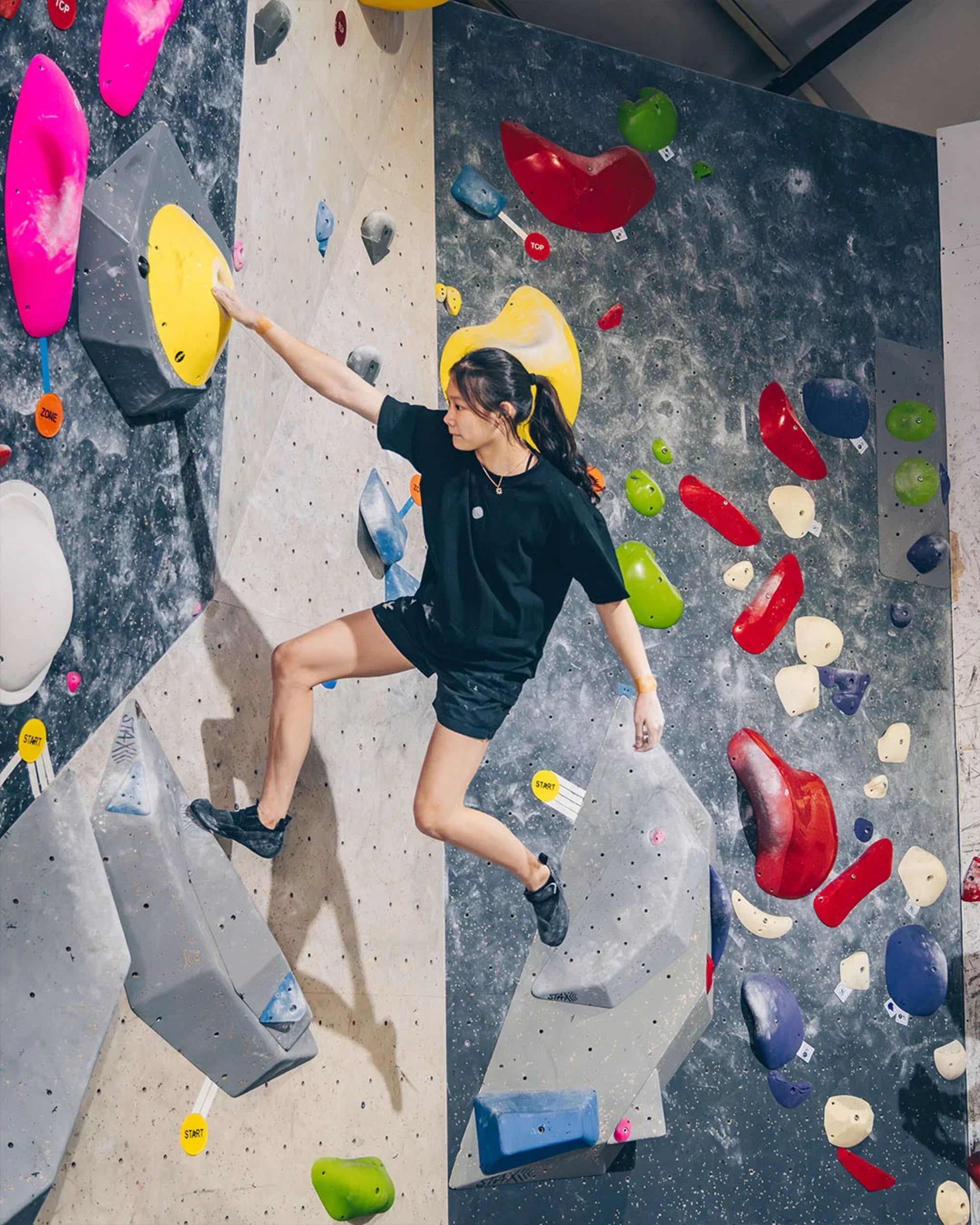
Grades are one of the first things beginners ask about in bouldering — and one of the most misunderstood. The instinct is to treat them like a universal ranking system, the way belt colours work in martial arts or lap times work in running. They're not quite that. Grades are approximate, context-dependent, and vary significantly from gym to gym, especially in Singapore.
This article explains how bouldering grades work internationally, why Singapore gyms do it differently, and how to use grades usefully as a beginner without getting too attached to the numbers.
How International Grading Systems Work
There are two main grading systems used internationally for bouldering: the V-scale and the Fontainebleau scale.
The V-scale — also called the Hueco scale — runs from V0 (beginner accessible) through V17 (the current upper limit of what humans have climbed). It's the dominant system in North America and used widely around the world.
The Fontainebleau scale originated in France and is more common in Europe. It uses a combination of numbers and letters — 4, 5, 6a, 6b, 6c, 7a, and so on. The scales overlap roughly: V0 is around 4–5 in Font, V5 is around 6c, V10 is around 7c+.
Both scales are set by individual route setters based on their own experience and feedback from other climbers. Grades are subjective by nature — a problem that feels like V4 to one setter might feel like V5 to another. The further you get from beginner grades, the more variability you see. This is normal and expected, even at the international level.
Why Singapore Gyms Use Their Own Systems

Most bouldering gyms in Singapore don't use V-grades or Fontainebleau grades on their walls. Instead, they use colour-coded or symbol-based systems that map to an internal difficulty scale specific to that gym.
The reasons are practical. V-grades and Font grades require setters to calibrate against an international standard that assumes experience climbing on natural rock and across many different gyms and countries. Most gym climbers — especially beginners — don't have that reference point, and imposing an international scale on a gym environment creates more confusion than clarity.
Colour systems are simpler to communicate and easier to navigate visually on a wall. A beginner walks in, is told "start with grade 1," and has an immediately clear framework for the session. They don't need to know what V0 means internationally to understand that grade 1 is easier than grade 5.
The trade-off is that grades don't transfer between gyms. A number that represents one difficulty at one gym may not represent the same difficulty at another. The same climber might feel like they're performing very differently depending on which gym they visit — not because their ability has changed, but because the grading standards differ.
What the Grades Actually Mean in Practice
In most Singapore gyms, the easiest grade is designed to be completable by a complete beginner within their first few sessions — holds are large, movement is straightforward, wall angle is gentle. The hardest grade in the same gym represents problems that challenge experienced, strong climbers. Between those two ends is the full range of movement, strength, and technique that the sport demands.
Progression through grades is rarely linear. Climbers often find they can complete problems at a certain grade on one style of wall — vertical, for example — but struggle on the same grade on an overhang. Grades indicate difficulty within a style and angle, not overall climbing ability. A climber who's strong on vertical walls and weak on overhangs might flash the hardest vertical problems in the gym while failing the easiest overhang problems. This is normal and reflects specific skill gaps rather than inconsistent grading.
How to Use Grades as a Beginner

The most useful thing grades do for beginners is give you a starting point and a direction. On your first few sessions, the easiest grade tells you where to spend most of your time. Once you're completing most problems at that level, the next grade up shows you where the new challenge is.
Avoid using grades as a score. The climber who can flash the second-easiest grade consistently has better technique than the one who struggles up the hardest grade with poor form. What matters in the early months is movement quality, not grade level. Rushing to harder grades before fundamentals are solid is one of the most common beginner mistakes — it builds bad habits that take much longer to unlearn than to avoid in the first place.
Don't compare your grades to other gyms or to climbers who train elsewhere. The only meaningful comparison is your own progress within the same gym over time. If you're completing problems today that you couldn't complete a month ago, you're improving — regardless of what colour, symbol or number is attached to the route.
When Grades Start to Matter More
Grades become more meaningful as you progress and start climbing across multiple gyms, and outdoors. At that point, having a rough sense of where your climbing sits on an international scale helps you choose appropriate challenges when visiting new venues and communicate your level to other climbers.
Most intermediate Singapore gym climbers who start climbing outdoors — at crags in Malaysia, Thailand, or elsewhere in the region — find the calibration process straightforward after a few sessions. The movement skills transfer directly; the grade reference just needs a few sessions to recalibrate.
A Practical Note on Asking About Grades
When you arrive at a new gym, ask staff two things: what does the easiest grade look like, and what does the mid-range grade look like. That gives you enough context to navigate the session without needing to understand the full scale immediately. Most gym staff are happy to explain the system and point you toward appropriate problems for your level.
If you're visiting a gym for the first time after climbing elsewhere, start one colour below where you think you should be. Warming up on slightly easier problems than your level is good practice regardless, and it gives you time to calibrate to the specific style and standards of that gym before committing to harder attempts.
Key Takeaways
- International bouldering grades — V-scale and Fontainebleau — are subjective and set by individual route setters
- Most Singapore gyms use their own colour or symbol systems rather than international grades
- Gym grades don't transfer between gyms — the same colour can mean different things at different venues
- Grades vary by wall angle and style — being strong at one grade on vertical doesn't mean the same grade on overhang will feel the same
- As a beginner, use grades for direction rather than as a score — movement quality matters more than grade level
- When visiting a new gym, ask staff to explain the grading system and start one level below your usual

Share:
What to Expect at Your First Bouldering Session
What Gear Do You Need to Start Bouldering?